Meaningful Participation in Daily Life: Rethinking Independence with Essential for Living
Oct 24, 2026

Gregory P. Hanley, Ph.D., BCBA-D
April 15, 2024
Introduction
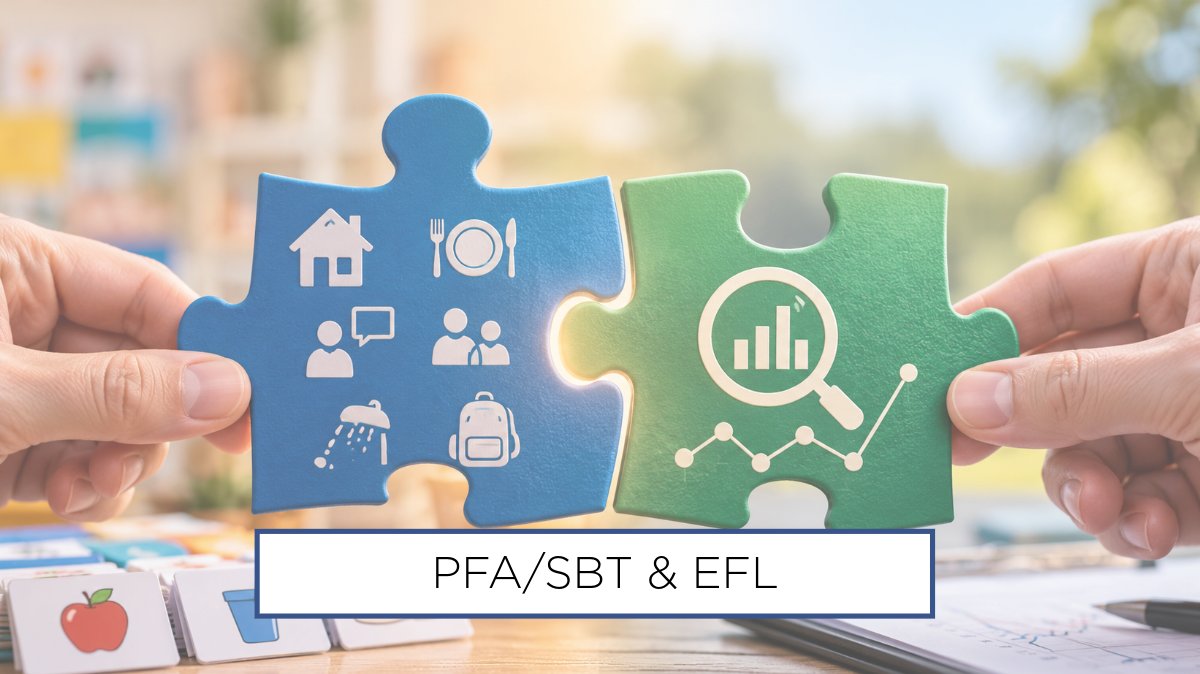
In the evolving field of Applied Behavior Analysis (ABA), the focus is increasingly shifting toward building skill repertoires in individuals with moderate-to-severe disabilities, including, but not limited to, autism spectrum disorders. Behavior analysts like Greg Hanley, Patrick McGreevy, and Troy Fry have been instrumental in this transformation, emphasizing the need for practical, skill-based learning. This blog explores two key approaches in this realm: Essential for Living (EFL) and the Practical Functional Assessment and Skill-Based Treatment of Problem Behavior (PFA/SBT).
What is Essential for Living (EFL)?
Essential for Living (EFL) is a comprehensive assessment and curriculum designed specifically for children and adults with moderate-to-severe disabilities and limited skill repertoires. This instrument includes practical life skills, rather than skills that are referenced to ‘typical development’ or ‘academic standards.’ EFL targets communication, language, and daily living skills, ensuring that these individuals with disabilities are equipped to lead more independent and fulfilling lives.
EFL is about understanding and meeting the unique needs of each individual. Developed by Dr. Patrick McGreevy and Troy Fry, MS, BCBA is not just an assessment tool; it's a comprehensive curriculum that guides educators and therapists in developing instructional plans that improve quality of life.
An Overview of the Practical Functional Assessment and Skill-Based Treatment of Problem Behavior (PFA/SBT)
The Practical Functional Assessment (PFA), developed by Dr. Greg Hanley and his colleagues, marks a significant shift in the assessment of challenging behaviors in individuals with autism and other developmental disabilities. It begins with an open-ended interview designed to reveal qualitatively rich information regarding the putative events that evoke problem behavior and the reinforcers responsible for its maintenance. The interview is also designed to identify the topographies of both dangerous problem behaviors and associated non-dangerous problem behaviors. The information gathered in the interview is then used to design an analysis to test whether the variables reported to influence problem behavior actually influence problem behavior. Such an understanding suggests that the behavior analyst may safely proceed to treatment while leveraging the power of synthesized reinforcement to teach the skills of communication, toleration, and cooperation. Since the original demonstration of the effects of PFA/SBT (Hanley et al., 2014); there have been 16 replication studies and two review papers published.
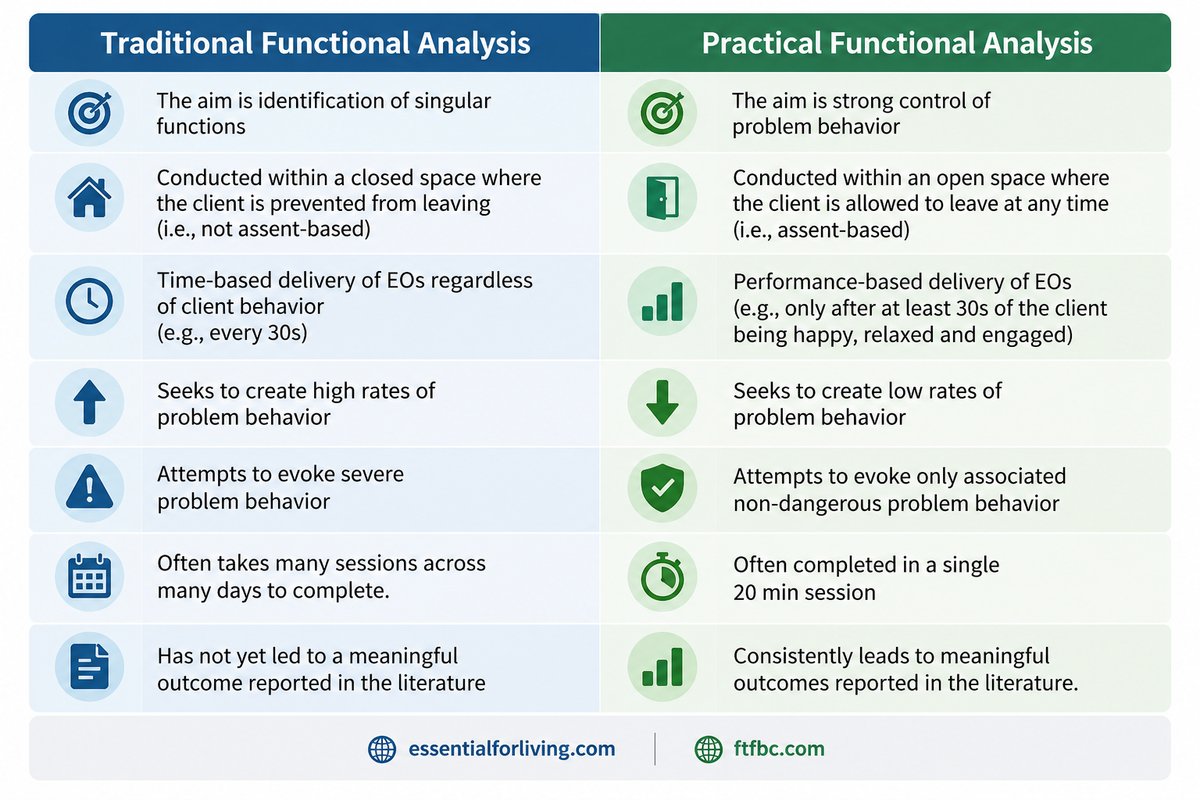
The Interview-Informed Synthesized Contingency Analysis (IISCA) offers a more humane, person-centered approach to understanding problem behavior prior to its treatments relative to historical functional analysis procedures. Please see the chart below for some comparisons.
Transitioning from PFA to Skill-Based Treatment (SBT) is a natural progression. SBT, as highlighted in Dr. Hanley's "A Perspective on Today's ABA," is about building skills that replace challenging behaviors with more effective, socially appropriate forms of communication. This approach aligns perfectly with the modern ethos of ABA, which is more respectful, person-centered, and trauma-sensitive. It's about creating learning environments where individuals feel safe, happy, and ready to engage - a stark contrast to the more restrictive practices of the past.
Skill-based Treatment is a contemporary, compassionate, and trauma-sensitive form ABA for treating severe problem behavior. Procedurally, it’s the intermittent and unpredictable reinforcement of the life skills of communication, toleration, and cooperation.
Skill-Based Treatment (SBT) represents a paradigm shift in how behavior analysts treat problem behavior, especially for individuals with moderate-to-severe disabilities. The key to SBT is its focus on teaching functional skills that empower individuals to communicate effectively, how to tolerate delays and denials to reinforcement, and how to engage in contextually appropriate behavior while waiting to regain access to their reinforcers. Unlike traditional methods that may focus solely on reducing undesirable behaviors, SBT aims to replace these behaviors with practical skills, thus addressing the root causes of behavioral challenges. This approach is highly individualized, considering each person's unique needs, preferences, and life context.
SBT involves the development of an individually tailored intervention plan. This plan focuses on skill acquisition in areas critical for the individual's daily living, social interaction, and personal development. The steps of SBT include:
FCR: Functional Communication Response (omnibus mand)
TR: Tolerance Response
Cooperation: Contextually Appropriate Behavior (CAB)
CAB1: Relinquishing reinforcers
CAB2: Transitioning to a workspace
CAB3: Starting to do a little work
CAB4: Varying the kinds of work done
CAB5: Enduring larger amounts of work
CAB 6: Persisting with work while being challenged
Treatment Extensions: Generalization and Maintenance
New people, locations, branches, specific mands, and gray reinforcement
This is where the results from the EFL Quick Assessment or the over 3100 skills in Essential For Living can be integrated into the SBT-based plan. Both go hand-in-hand, as EFL provides skills to work on and develop, with SBT as the base strategy for working on developing these new skills.
The modern approach of “Today’s ABA” or of today’s Applied Behavior Analysis has been shaped by many practitioners, including the contributions of experts like Greg Hanley, Patrick McGreevy, and Troy Fry. Their work not only provides the foundation for practices like Essential for Living (EFL) and the Practical Functional Assessment and Skill-Based Treatment of problem behavior (PFA/SBT) but also guides the evolution of ABA towards a more humane, effective approach.
Greg Hanley's influence is especially notable in the realm of PFA/SBT, where his emphasis on understanding the individual's perspective and context has revolutionized behavioral assessment. His approach is deeply rooted in respect and empathy, marking a significant shift from more traditional, prescriptive methods.
Patrick McGreevy has been instrumental in developing EFL, a curriculum that prioritizes practical, real-world skills for individuals with moderate to severe disabilities. His work acknowledges the diverse needs and abilities of this population, offering a more inclusive and effective framework for learning and development.
Troy Fry's contributions are equally significant. His work in integrating these approaches into practical, day-to-day therapy and education strategies has been invaluable in making these behavior analytic approaches accessible and applicable to those working directly with individuals with disabilities.
Together, these experts have not only advanced the field of ABA but have also ensured that it remains responsive to the needs and dignity of individuals with disabilities. Their work underlines the importance of continuous learning and adaptation in the practice of ABA, ensuring it remains relevant and effective in changing times.
The integration of Essential for Living (EFL) and Skill-Based Treatment (SBT) in practical settings is a vital aspect of contemporary Applied Behavior Analysis. Below is a side-by-side comparison of how the essential eight skills of EFL align with the steps of SBT:


There is a significant amount of overlap not only with the skills taught in EFL and SBT, but also in the values. Both are performance-based, and changes are made in response to learner behavior and preferences. Many practitioners use EFL as the guidebook for choosing the meaningful skills for a learner. For many practitioners, EFL informs the direction of programming while using SBT as the technology to achieve the goals for students. (Personal correspondence with Mara Vanderzell and Emily Beal Wilkinson)
Freedom from severe problem behavior, greater community involvement, and increased quality of life is attainable for all persons. It is attainable through the complementary processes of Essential for Living and Skill-Based Treatment.
EFL provides the framework for identifying essential life skills and setting learning objectives, while SBT offers the strategies and techniques to teach these skills. In practice, this combination allows for a more holistic approach to therapy and education. For instance, through EFL, a behavior analyst might identify communication as a key skill for an individual, and even use some of the tools like the Alternative Methods of Speaking Tool (AMS tool) to further inform the best skill to work on teaching, and then combine that with the SBT techniques to teach effective communication methods.
The synergy between EFL and SBT is particularly beneficial in creating personalized learning experiences that respect the individual's abilities and preferences. This approach ensures that each person receives the most appropriate and effective support, leading to better outcomes in terms of independence, social integration, and overall quality of life.
Browse the complete Essential for Living collection — books, bundles, and digital resources for ABA professionals and educators.
Insights, updates, and resources for ABA professionals, educators, and parents.