Classroom Design: Use it to Cue the Behavior You Want to See
Oct 11, 2026

Miguel Avila, MA, BCBA
October 24, 2026
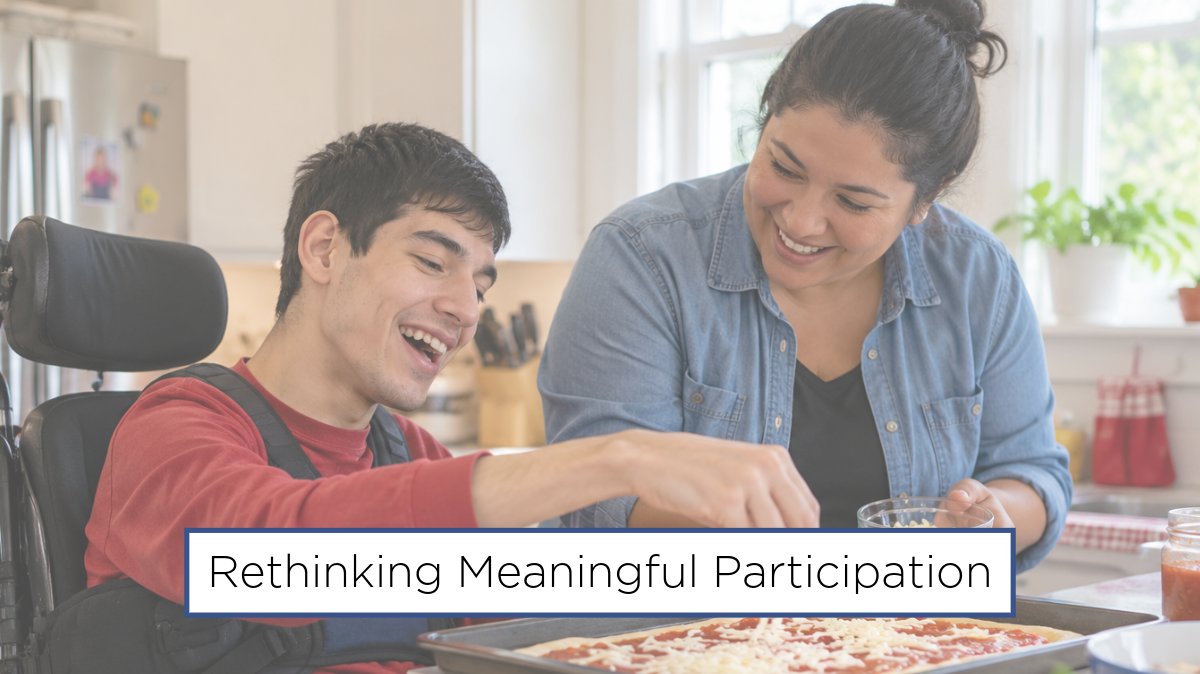
Essential for Living (EFL) encourages teams to look beyond whether a learner can complete an activity independently. A more useful focus is how that learner can take part meaningfully in the activity and in the life around them.
This way of conceptualizing instruction was thoughtfully developed by Patrick McGreevy and Troy Fry and is reflected in the Essential for Living Teaching Manual. It represents a philosophy of teaching that prioritizes participation, dignity, and quality of life rather than rigid notions of independence. Instead of viewing support as something to eliminate at all costs, EFL encourages us to arrange environments and instruction so learners can participate meaningfully in the events that make up everyday life.
Too often, instruction focuses on isolated skills in brief, adult-led teaching opportunities that may not represent real-life expectations. For many children and adults with limited skill repertoires, concepts such as later, tomorrow, similar, or even the number two can be abstract and difficult to experience directly. When learners struggle with these concepts, we may conclude that they are not ready or that teaching should be postponed.
The EFL framework offers another option. Rather than waiting for perfect understanding before inviting participation, we can redesign environments and teaching arrangements so learners can experience success, contribution, and connection now.
Many concepts become easier to understand when they are encountered in real life rather than explained in isolation. Instead of teaching numbers, time, categories, and sequences only as abstract academic exercises, we can embed them within setting the table, preparing meals, sorting laundry, feeding pets, shopping for groceries, gardening, caring for personal belongings, and participating in family routines.
These moments are not interruptions to instruction. They are instruction.
They are where skills become meaningful because they are immediately connected to outcomes that matter to the learner and the people around them. A learner who retrieves a spoon during meal preparation is not merely demonstrating a listener response. The learner is contributing to an event that occurs in everyday life.
For more on the EFL framework, see the Essential for Living overview. For related instruction organized around recurring daily events, explore the Essential for Living introductory course.
The Essential for Living Teaching Manual discusses what McGreevy and Fry call “work arounds.” These are thoughtful adaptations to materials, prompts, environments, or routines that allow learners to achieve meaningful outcomes through different pathways.
A learner who struggles to collect a specified number of items following a spoken request may benefit from an adapted counting arrangement. Someone who communicates through signs or pictures may use visual supports or numbered cards to accomplish the same goal. Another learner may use photographs to support listener responding when asked to retrieve items such as milk and a spoon.
The important question is whether the learner can contribute to an outcome that matters in daily life. When an adaptation makes that possible, it is serving its purpose.
Independence is valuable, but it is not the only meaningful outcome. Many meaningful activities involve collaboration, assistance, and shared responsibility. Families cook together. Coworkers divide responsibilities. Friends help one another move furniture. Partners complete projects together. Support and participation are not opposites. For one learner, participation might mean gathering ingredients while another person cooks. For another, it might mean loading dishes into the dishwasher while a family member starts the machine. Someone else might place clothes in the washing machine while another person measures the detergent. The learner contributes what they can contribute. The environment supplies the rest. This is not failure. This is belonging. Partial participation can also create opportunities to learn additional skills over time, rather than postponing access to meaningful experiences until an entire routine is mastered.
Patrick McGreevy and Troy Fry encourage us to think differently about shared skills, activities completed together by a learner and another person. Rather than assuming every support must be faded as quickly as possible, shared skills acknowledge that some assistance may appropriately remain when it maximizes meaningful participation. After all, human beings live interdependently. Most of us rely on reminders, calendars, GPS systems, calculators, grocery lists, and smartphones to participate successfully in everyday life. We do not call those failures of independence. We call them tools. Our learners deserve access to tools and supports as well.
Some learners may not be able to independently perform the physical movements involved in a particular activity, even with extensive teaching or prompting. Participation can still take another form: engagement. A learner might reach toward a spoon while someone helps complete the movement, activate a switch during cooking, choose the next ingredient, look toward an object, vocalize, smile, anticipate, or make small movements that indicate involvement. Teams should interpret these responses in light of the individual's own communication repertoire and preferences, rather than assuming a single movement always means the same thing. These moments matter. Participation is not defined solely by productivity. Being included in an experience can have value even when the learner's physical contribution is limited.
When we shift our focus from independence alone to participation, our teaching changes. We begin by empowering learners as speakers who can influence their circumstances. We then carefully and predictably build functional skills related to waiting, transitions, relinquishing items, and tolerating necessary situations, while creating opportunities for safe participation in meaningful events. Instead of asking only, “How do I get this learner to complete the entire task?” or “How do I fade every prompt?”, we can ask:
What part of this event can the learner own? How can they contribute? How can we adapt the environment to increase success? How can we preserve dignity while maximizing participation? How can we arrange safe participation?
These questions can lead to more compassionate, effective, and functional instruction. They also direct our attention toward the learning environment and instructional arrangements, rather than treating every barrier as a deficit within the learner.
One of the greatest strengths of Essential for Living is its reminder that instruction extends beyond teaching isolated skills. The larger aim is to help people participate in experiences that make up a meaningful life: preparing meals with family, helping care for a younger sibling, setting a table before guests arrive, watering plants, choosing music for a road trip, celebrating birthdays, and contributing at home, in the community, or at work.
These activities create opportunities to be included, to be needed, and to contribute alongside other people. Whether participation is independent, partial, shared with support, or primarily engagement-based, the goal remains the same: creating opportunities for learners and their families to experience competence, contribution, connection, joy, and a better quality of life. Because dignity is not earned through independence. Dignity belongs to every person.
As McGreevy and Fry have helped articulate through the Essential for Living framework, our responsibility is to conceptualize instruction so every learner, regardless of current abilities, has a meaningful way to participate in everyday life.
Practitioners who want to apply these ideas can explore the Essential for Living curriculum and training materials and the Essential for Living introductory course.
Browse the complete Essential for Living collection — books, bundles, and digital resources for ABA professionals and educators.
Insights, updates, and resources for ABA professionals, educators, and parents.