Using Essential for Living and Event-Based Teaching to Prepare Students for Life After 21
Oct 14, 2026

Dr. Patrick McGreevy
October 24, 2026
A learner can identify a cup during instruction. Later, when someone needs a drink, that same learner waits for an adult to find one. Across the room, another learner practices requesting with a therapist but rarely directs a request to a peer.
For a Board Certified Behavior Analyst (BCBA), these moments raise an important question: How can we arrange instruction so that learners use essential skills in the situations where those skills matter?
The question becomes more complicated in a classroom or ABA center. Several learners may share a space while needing different communication supports, teaching targets, and amounts of assistance. A group activity can easily become a series of individual lessons, with everyone else waiting.
Event-based teaching offers a practical way to organize that instruction. Developed through the classroom work of Kristina Montgomery and Emily Beal Wilkinson, building on Essential for Living (EFL), it brings individualized goals into meaningful, recurring activities.
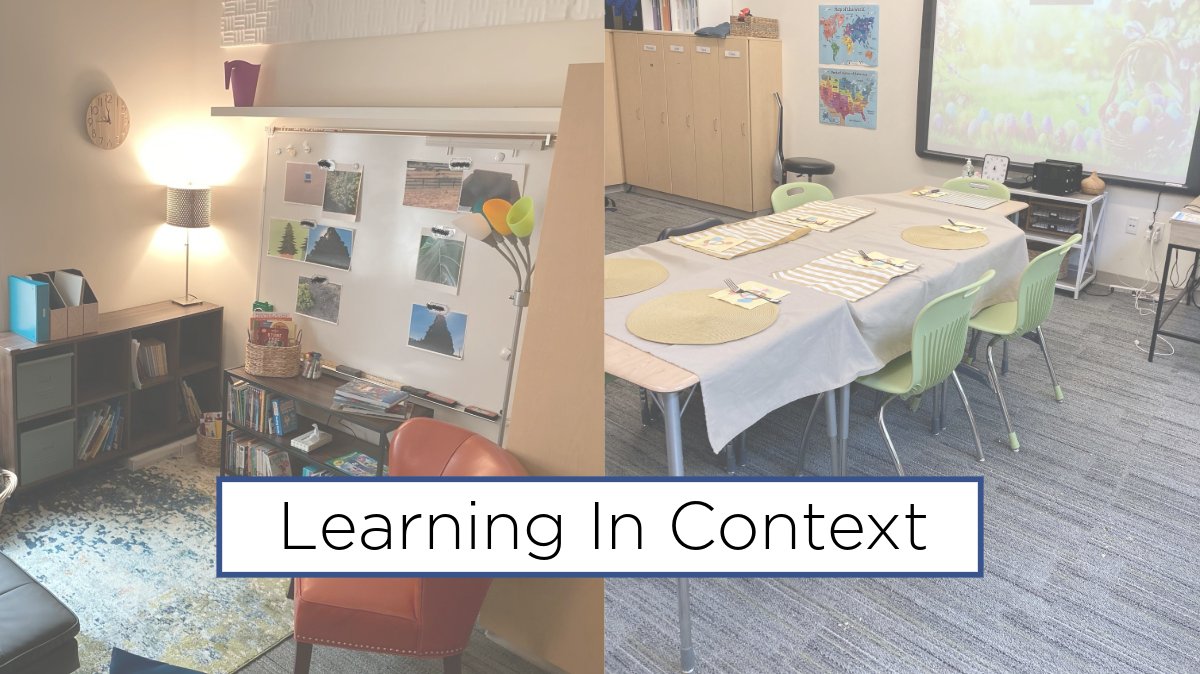
A classroom café, for example, can provide reasons to request, retrieve materials, serve someone, and clean up. The shared activity holds the teaching together. Each learner’s goals still guide what happens within it.
Event-based teaching organizes instruction around meaningful, repeatable events in which learners practice skills they need to participate. Preparing a snack, tending a garden, hosting a café, or making something for a celebration can each provide a context for teaching multiple individualized goals.
The approach builds on EFL’s emphasis on teaching essential skills within events and evaluating their value in everyday life. EFL helps practitioners determine which skills matter for a particular learner. An event provides a place to teach, practice, and maintain selected skills together.
Kristina and Emily use the idea of “stacking” to describe how several goals can fit within one activity. During snack preparation, a learner might request help to open a container, retrieve a spoon, and carry a bowl to the table. These actions contribute to something the learner can experience: preparing and enjoying a snack.
The practitioner deliberately arranges those opportunities. Materials, communication supports, prompting, reinforcement, and data collection all require planning. An activity does not become effective instruction simply because it resembles everyday life.
The event also has a beginning and an aftermath. Preparing materials creates opportunities to recognize and retrieve items. Using those materials creates opportunities for participation. Cleaning up creates reasons to wash, wipe, sort, and put things away.
That continuity is especially useful in group settings. Learners can contribute differently while participating in the same event, and the teaching can extend across a routine that the team repeats.
Kristina Montgomery’s path into behavior analysis began with an interest in people. As an undergraduate at the University of Oregon, she studied anthropology and women’s studies. Work in a specialized mental health school introduced her to children with disabilities and to professionals collaborating across education and therapeutic services.
Around the same time, a family connection brought autism services into her life. Attending a presentation by Vince Carbone introduced her to behavioral approaches to teaching language. She was drawn to the combination of analysis, creativity, and the possibility of making a practical difference.
Kristina began working directly with learners before pursuing graduate study at Teachers College, Columbia University. Her training combined applied behavior analysis with teacher preparation. That connection between teaching and analysis became particularly relevant in her work at Victory Academy, where her experience has included classroom teaching and behavior analytic consultation across classrooms.
Her introduction to Essential for Living came through a workshop with Dr. Patrick McGreevy. She attended with particular learners in mind: students whose progress had raised questions about whether the team was teaching the right skills in the right way. EFL offered a different basis for those decisions, centered on skills with lasting usefulness.
Bringing that perspective back to a school required more than enthusiasm. Kristina initially worked to introduce the ideas while consulting across classrooms. Later, attending training with a larger group of colleagues helped establish a shared understanding and a stronger foundation for implementation.
Her contribution to event-based teaching reflects that sustained classroom problem-solving. She explored whether skills demonstrated during isolated instruction were available in the activities where students needed them. She also drew inspiration from reading outside behavior analysis, including the idea that one activity could meet several needs.
Together with Emily and their colleagues, Kristina developed ways to arrange repeated events that could accommodate several teaching goals. Continued mentorship from McGreevy and Troy Fry helped connect those classroom decisions with EFL’s broader purpose.
Her story is relevant to school consultants because it includes a familiar challenge: translating an assessment and curriculum into teaching that a classroom team can carry out, revisit, and improve over time.
Emily Beal Wilkinson entered the field through teaching and a persistent concern about whether her instruction was helping. After completing her undergraduate education at California State University, Northridge, she established a tutoring business and worked with students who had different academic needs.
One student struggled despite considerable effort from both of them. When an evaluation identified a reading disorder, Emily recognized that she needed a deeper understanding of learning difficulties. That experience led her to graduate study at the University of Southern California, where she focused on reading, writing, and mathematics disorders and prepared as a reading specialist.
Her subsequent work included supporting student athletes at the University of Oregon and working in clinical settings. As she gained more exposure to applied behavior analysis, she became particularly interested in its use of measurement to guide teaching. She completed additional coursework and became a BCBA.
At Victory Academy, Emily joined Kristina in examining the needs of learners whose progress had become limited. EFL’s focus on meaningful skills helped them reconsider what they were asking students to learn and how those skills connected with daily life.
Emily’s background also brought an appreciation for hands-on educational experiences. In event-based teaching, that perspective appears in the role of the adult: leading an activity, participating alongside learners, and inviting contributions that match their abilities and interests. A learner can enter an event through a manageable role and build from there.
She has emphasized the importance of asking families better questions. Understanding what makes daily routines difficult, what families hope to do together, and what a learner enjoys can change the direction of programming. Those conversations help practitioners choose events with relevance beyond the teaching setting.
Emily also brings attention to the experience of the people delivering instruction. An event that draws on a teacher’s interests can be easier to sustain and offers a shared activity that the adult enjoys leading.
Her contribution complements Kristina’s classroom and analytical perspective. Together, their work connects individual learning needs, family priorities, and the practical organization of instruction. For practitioners, Emily’s background reinforces a useful habit: when progress stalls, examine the fit between the learner, the goal, and the experience of being taught.
For BCBAs exploring alternatives to discrete trial training (DTT), event-based teaching offers a different way to package instruction. DTT organizes teaching into discrete opportunities with a clear response and consequence. Event-based teaching organizes opportunities within an activity that has an ongoing purpose.
These descriptions operate at different levels. An event can still include carefully planned prompts, repeated practice, and explicit teaching of a difficult step. Choosing an event does not remove the need for instructional precision.
The practical question is whether the arrangement helps this learner acquire and use the selected skill. If a learner identifies utensils during individual instruction but cannot retrieve one to prepare food, the team needs to examine that gap. Teaching within food preparation puts the relevant materials, actions, and outcomes together from the beginning.
That does not establish generalization to every other setting. Practitioners still need to check performance with different people, materials, and routines, and teach where additional support is needed.
Event-based teaching is also more specific than simply moving a lesson away from a table. The defining feature is the relationship between the skill and the event. Wiping a surface after preparing food contributes to cleaning up. The surrounding activity gives the response a practical function.
The following hypothetical story illustrates instructional planning; it is not a reported case or a prediction of results.
Maya, a BCBA consulting in a school district, visits a classroom where the team is working hard to teach individual goals. Students practice communication, matching, and daily living skills with adults. During group time, however, the teacher struggles to give everyone a useful role.
One student finishes quickly. Another needs substantial assistance. A third spends much of the activity waiting for an adult’s attention. The teacher wants a shared experience, but the group often breaks into separate lessons around the same table.
Maya and the teacher decide to build a Friday café. They begin with a limited menu, materials, and invited staff members. Adults handle hot liquids. Students help prepare the space, offer items, deliver orders, and clean up, with roles selected around their interests and learning needs.
Before opening, Maya maps a few goals for each learner. Jordan practices using his communication device to request an item from a peer. Elise practices retrieving cups and napkins from their storage locations. Mateo, who reads familiar words, works from a short order slip to assemble a tray.
The teacher leads the café while supporting staff know which opportunities to watch for. They record whether selected responses occur independently or with assistance. Students can take breaks and return to manageable roles. Nobody has to perform every job to belong in the activity.
The first café reveals problems. Too many visitors arrive together. Jordan needs help directing his request toward the student serving him. Elise can find cups but becomes uncertain when the napkins are stored elsewhere. Maya treats those observations as information for the next event.
The team reduces the number of visitors, stabilizes the materials, and rehearses staff responsibilities. They preserve the café’s purpose while adjusting the teaching. During the week, preparation provides additional opportunities: gathering supplies, checking the menu, and setting out trays for Friday.
Across later cafés in this imagined scenario, Jordan begins directing some requests to the peer who has the requested item. Elise retrieves familiar supplies with less assistance. Mateo completes his tray routine but still needs support when an order changes. The data show different patterns for different learners.
The teacher now has a repeatable group format with clear individual targets. Maya can coach the team within the activity and make specific adjustments, rather than repeatedly writing separate group lessons. Cleanup extends the teaching into wiping tables and returning supplies after customers leave.
The café resolves the original organizational problem: students can participate together while receiving individualized instruction. Their contributions have an immediate place in the activity, and the teacher can see what each learner is working toward. The team still has skills to teach and arrangements to improve.
For a school consultant, that is the practical promise of event-based teaching: a shared routine that makes individualized goals workable in a classroom, with progress judged by what each student can actually do within the event over repeated opportunities.
This hypothetical story illustrates how the same planning approach might work in an ABA center.
Daniel, a BCBA supervising a team, notices a disconnect. Several learners identify familiar objects during individual sessions, and some request preferred foods from their therapists. During snack, staff retrieve everything, open containers, distribute food, and clear the tables while learners wait.
The team has been treating snack as a pause between teaching blocks. Daniel sees an opportunity to connect existing goals with a routine that already happens. After discussing preferences, dietary needs, and family priorities, he proposes a snack preparation and serving event on afternoons.
He starts with food and manageable jobs. The event includes washing hands, gathering materials, preparing portions, choosing food, eating together when learners wish, and cleaning up. Food remains available regardless of whether someone completes a teaching target. Participation is supported through choices, assistance, and breaks.
Each learner’s plan identifies a small number of opportunities. Ava practices requesting help with a container. Ben practices recognizing and retrieving a bowl from the supply shelf. Luis enjoys carrying objects and begins by taking napkins to the table, later working toward delivering the number needed.
Daniel coaches staff to lead the routine while creating room for learner participation. They make communication supports available, provide planned assistance, and record selected responses. They avoid turning every movement into a demand or filling every pause with another question. The snack still needs to feel like snack.
Initially, the event is slower than staff preparation. Ben reaches for the nearest object instead of the bowl. Ava waits for an adult to open her container. Luis delivers napkins but keeps carrying additional ones because the end of his job is unclear.
Daniel narrows the targets and adjusts the arrangement. Ben practices with a simpler selection of materials. Ava receives the planned support for requesting help before frustration develops. Luis has a clear destination and quantity. Staff practice the changes together so support is consistent across the week.
In this imagined progression, Ava begins requesting help on some occasions without an adult first asking what she needs. Ben retrieves the familiar bowl more reliably but still needs teaching with a different bowl. Luis completes his delivery and returns to choose his snack.
Daniel reviews independence and assistance alongside whether learners approach the activity, remain comfortable, and choose to return. He also asks families whether similar routines would be useful at home. A family interested in participation during dinner preparation might identify a related opportunity, with teaching planned for that setting.
The center has solved a practical problem: useful instruction now occurs during a routine staff previously completed for learners. Snack preparation gives the team a recurring context for communication and participation, while their observations show where further teaching is needed. Success remains individual, and generalization is checked rather than assumed.
The change begins with an ordinary part of the afternoon. Its value comes from giving each learner a contribution and teaching the skills that make that contribution increasingly possible over time.
Both stories begin with an instructional arrangement that limits participation. Event-based teaching gives the BCBA a way to reconsider how the day is organized while keeping individual learning needs visible.
For school consultation, a recurring event can provide a shared plan for the teacher, paraprofessionals, and related team members. Instead of interpreting a long list of goals independently, staff can connect selected targets with recognizable moments in an activity. Coaching becomes concrete: who is teaching, when the opportunity occurs, and what support the learner needs.
For an ABA center, the same approach can bring instruction into routines that adults already manage. Preparing materials, serving food, and putting things away become opportunities to examine what learners could do with appropriate teaching. This requires thoughtful staffing and supervision; a shared activity does not automatically reduce support needs.
Events can also make functional outcomes easier to discuss with families. A goal such as retrieving a needed item becomes tangible when it helps someone participate in preparing dinner. Family input helps determine whether the event and its targets deserve a place in the learner’s day.
Finally, a stable event can change with the learner. A beginning role might involve one supported action. Later targets may include more independent communication, a longer sequence, or a different responsibility. The routine can remain familiar while the teaching advances.
Begin with one recurring activity that makes sense for your learners and setting. It should have a clear purpose, materials you can reliably access, and opportunities that connect with assessed priorities. A small, sustainable routine provides a better starting point than an elaborate event the team cannot repeat.
Choose goals before adding complexity. Identify what each learner can already do, what requires teaching, how the learner communicates, and what participation could look like with appropriate assistance. Include interests and preferences alongside instructional needs. Learners do not need identical goals or equal amounts of time in the activity.
Map opportunities across preparation, participation, and cleanup. For each selected target, specify the relevant cue, expected response, support, and outcome. Decide which adult leads the event and who provides individual assistance or records data. Rehearse those responsibilities before expecting staff to manage them in a busy group.
Plan enough practice. A recurring event can provide repetition across days, and some events offer several genuine opportunities within one session. But opportunity counts still matter. If the chosen routine rarely occasions a priority skill, add appropriate opportunities, choose another event, or provide additional individualized instruction.
Measure what you need to decide next. Track whether selected responses occur, the assistance required, and whether progress continues. Alongside skill measures, attend to the learner’s communication, choices, engagement, and individualized indicators of happiness or distress. A completed activity alone does not establish successful teaching.
Finally, check the skill where it matters beyond the original event. A learner who retrieves supplies in the center may need teaching in a home kitchen. Use those observations to extend instruction thoughtfully. The aim is an increasingly useful repertoire that supports participation and quality of life.
Event-based teaching gives practitioners a practical question to bring to their next planning meeting: What meaningful event could provide a reason for these learners to use the skills we are teaching?
Kristina and Emily’s work shows how that question can shape classroom organization, daily routines, and individual teaching decisions. It invites BCBAs to look across the day for activities that can hold several goals together while preserving each learner’s needs and preferences.
A thank-you to Matt Cicoria for hosting Kristina and Emily on Session 334 of the Behavioral Observations Podcast, where they discuss their experiences and the development of this approach. Their conversation offers an additional opportunity to learn more.
To explore how to design and deliver this instruction, visit the Essential for Living Event-Based Teaching course page. Hosted by The Behavior Academy, the course with Kristina and Emily offers a next step for practitioners who want to bring meaningful, in-context teaching into classrooms and other learning environments. View a course sample below!
Browse the complete Essential for Living collection — books, bundles, and digital resources for ABA professionals and educators.
Insights, updates, and resources for ABA professionals, educators, and parents.